Back to news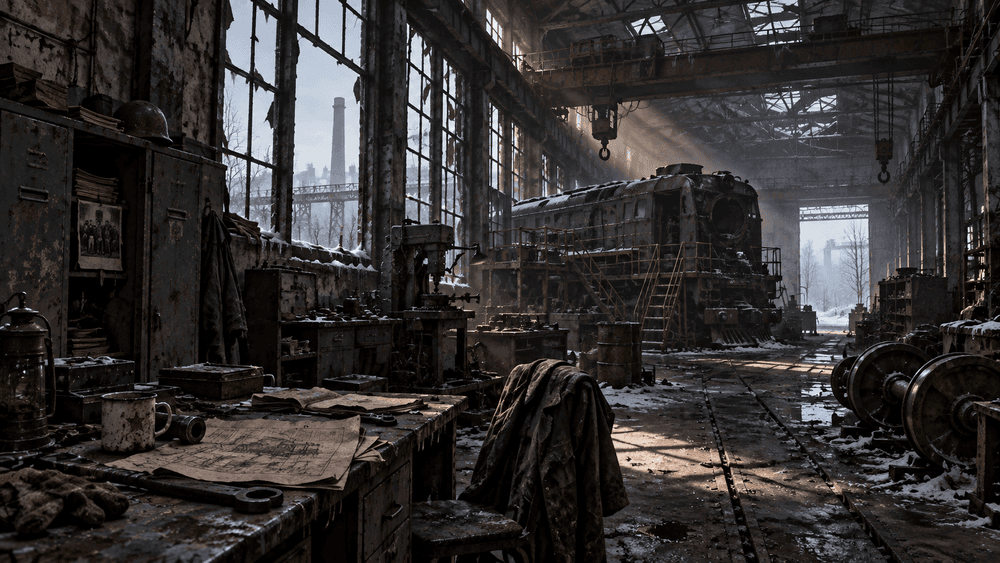
Archaeology of Decay
The visual direction for locations that carry a specific history instead of becoming interchangeable post-apocalyptic ruins.
The visual direction of BELORET begins with a simple question: what was this place before everything changed? A ruin is more convincing when its original purpose remains visible. A factory, research institute, apartment courtyard, roadside shop, and military checkpoint should not collapse into the same collection of concrete, rust, and scattered debris.
Places with a previous life
We are looking at post-Soviet material culture as evidence of ordinary life. Faded advertising, packaging, furniture, improvised repairs, public notices, abandoned vehicles, and personal belongings can establish who used a space and how it changed. In a research facility, equipment and access controls suggest one history. In a looted shop, empty shelving, broken storage, and the remains of hurried barricades suggest another.
Decay also has a timeline. The first damage may come from the catastrophe; later layers come from weather, neglect, scavenging, conflict, and attempts to settle the site again. A location can therefore show several different periods at once. The newest traces may be the most important to a survivor, because they indicate who passed through recently and what they were looking for.
- Rusting industrial complexes retain signs of their original function.
- Abandoned institutes and military sites reveal controlled, restricted spaces.
- Shops, vehicles, advertisements, and household objects anchor the world in post-Soviet material culture.
Beyond generic ruins
The aim is not to fill every room with exposition. Environmental details should work together so that players can form their own reading of a place. Some conclusions may be clear, while others remain uncertain. This “archaeology of decay” is one of the central worldbuilding principles we plan to use as locations develop: history should be present in structure, objects, and damage, not only in collectible documents.
Consistency matters as much as the quantity of detail. Materials should age according to their environment, objects should appear where their use makes sense, and damage should have a plausible direction. Repeated visual rules help players notice when something is unusual: a recently moved barrier or an unexpectedly clean room can then communicate information immediately. The concept is to make observation valuable while preserving restraint, so that significant traces stand out instead of disappearing inside undifferentiated visual noise.
New to BELORET?
BELORET is a multiplayer survival sandbox set in a fully fictional post-Soviet region inspired by the Southern Urals, Bashkortostan, and similar industrial and natural environments.

Field reports
Follow the development of BELORET.
Occasional notes on development, major changes and new BELORET material.