Back to news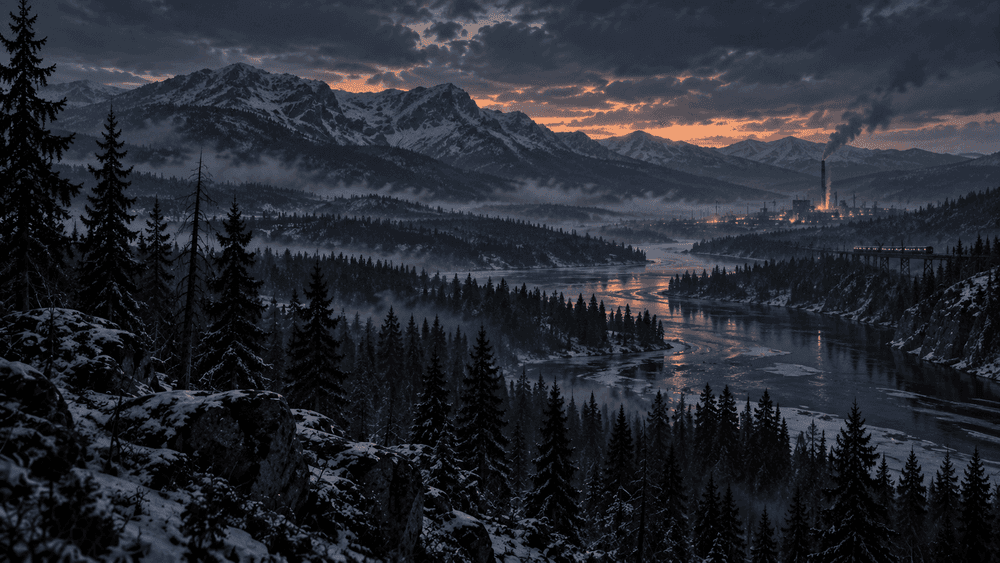
Building a Fictional Post-Soviet Region
How the Southern Urals, Bashkortostan, and similar industrial and natural environments inspire BELORET without defining a literal real-world location or one-to-one geography.
The Southern Urals, Bashkortostan, and similar industrial and natural environments are important references for BELORET rather than its literal setting. Their contrasts-industrial cities near forests and steppe, research infrastructure, military sites, and transport routes connecting settlements built for different purposes-help shape a fully fictional post-Soviet region. BELORET does not reproduce real geography one to one; its locations, distances, and history are created for the game.
Industry, isolation, and distance
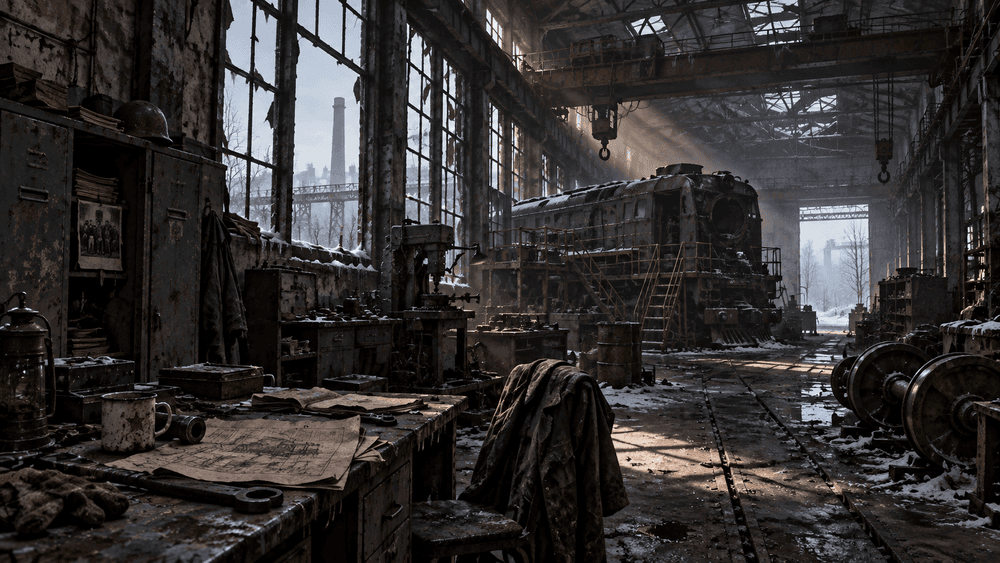
Factories, rail yards, power facilities, closed research sites, and military towns provide references for systems that once depended on one another. In BELORET’s fictional world, that infrastructure does not become a neutral collection of ruins after the catastrophe. Its original purpose continues to determine where resources can be found, which routes remain important, and what kinds of danger gather around them.
Post-Soviet material culture provides a distinctive visual language. Concrete public buildings, improvised repairs, faded signs, empty shops, abandoned vehicles, and domestic objects belong to a recognizable everyday world. In the concept, these details are not decoration. They give fictional places a coherent past and suggest what happened without requiring every answer to be written in a document.
An archaeology of collapse
We use the phrase “archaeology of collapse” for this approach. A location should tell its story through layers: what it was built for, how people adapted it during the crisis, and what later survivors took or left behind. Nature and heavy industry strengthen that contrast. A quiet forest edge can lead to a restricted facility; an exposed road can be more dangerous than the dark interior of a factory.
This direction is still being developed, but the principle is clear: the world should communicate the catastrophe through the places themselves. Exploration becomes a way of reading history, not simply moving between containers of resources.
These references also offer a useful sense of scale. A dense industrial district, a settlement built around one enterprise, and a remote installation can feel connected without becoming interchangeable. Travel between them can reveal gradual changes in architecture, terrain, and the traces left by people. This gives worldbuilding a continuous structure: the player does not leave one themed level and enter another, but reads how fictional geography and infrastructure shaped neighboring places differently.
New to BELORET?
BELORET is a multiplayer survival sandbox set in a fully fictional post-Soviet region inspired by the Southern Urals, Bashkortostan, and similar industrial and natural environments.
Field reports
Follow the development of BELORET.
Occasional notes on development, major changes and new BELORET material.